

 English
 中文简体
中文简体
Is Double Weave Right for Your Technical Application?
2026-03-12
Selecting the right weaving technology requires understanding structural capabilities. Many buyers confuse double weave with simple heavy fabrics. They overlook the engineering possibilities of interconnected layers. This guide examines weaving double weave from a textile engineering perspective. It helps technical textile purchasers make informed sourcing decisions.
Suzhou Redcolor International Trading Co., Ltd. operates with subsidiaries. These include Suzhou LJC Textile Co., Ltd. and Wujiang Jiabaokang Textile Co., Ltd. The company functions as China Custom High Performance Polyester T400 Stretch Fabric Manufacturers. It operates as China ODM/OEM High Performance Polyester T400 Stretch Fabric Suppliers. The enterprise integrates spinning, texturing, weaving, and trade. The company maintains two production bases. These are located in Wujiang, Suzhou, and Siyang, Suqian. Annual output reaches approximately 60 million meters of various textiles. Shell and lining materials sell to international markets. These include the United States, Europe, and Southeast Asia. Domestic markets also purchase these materials. The company adheres to high-quality concepts. It serves every customer with better products.
Content
- 1 Understanding Double Weave Technology
- 2 Double Weave Fabric Technical Textile Applications
- 3 Air Jet Loom Double Weave Production
- 4 Double Weave Jacquard Pattern Design
- 5 Industrial Double Weave Filter Fabric
- 6 Double Weave vs Triple Weave Comparison
- 7 How to Evaluate Double Weave Suppliers
- 8 Frequently Asked Questions
- 8.1 What is the minimum order quantity for custom double weave fabrics?
- 8.2 How do you ensure layer alignment in double weave production?
- 8.3 Can double weave fabrics achieve different properties on each face?
- 8.4 What lead times should we expect for double weave orders?
- 8.5 Do you provide technical documentation and certification?
- 9 Conclusion
- 10 References
Understanding Double Weave Technology
What Defines Double Weave Structure?
Double weave creates two distinct fabric layers simultaneously. These layers interconnect at specific points. The structure differs from thick single-layer fabrics. True double weave maintains separate top and bottom faces. Binding threads join these faces at controlled intervals.
Structural characteristics include:
- Two independent warp systems (top and bottom layer)
- Two independent weft systems (top and bottom layer)
- Binding warp or weft threads creating interlayer connections
- Variable binding frequency determining layer separation
- Ability to create tubular or pocket structures
Binding types determine fabric behavior:
- Warp binding: Warp threads interlace between layers
- Weft binding: Weft threads interlace between layers
- Double binding: Both warp and weft create connections
- Stitched binding: Additional stitching threads join layers
Loom Requirements for Double Layer Formation
Double weave requires specific loom capabilities. Standard looms weave single layers. Double weave needs enhanced shedding mechanisms. It requires precise tension control for two warp beams.
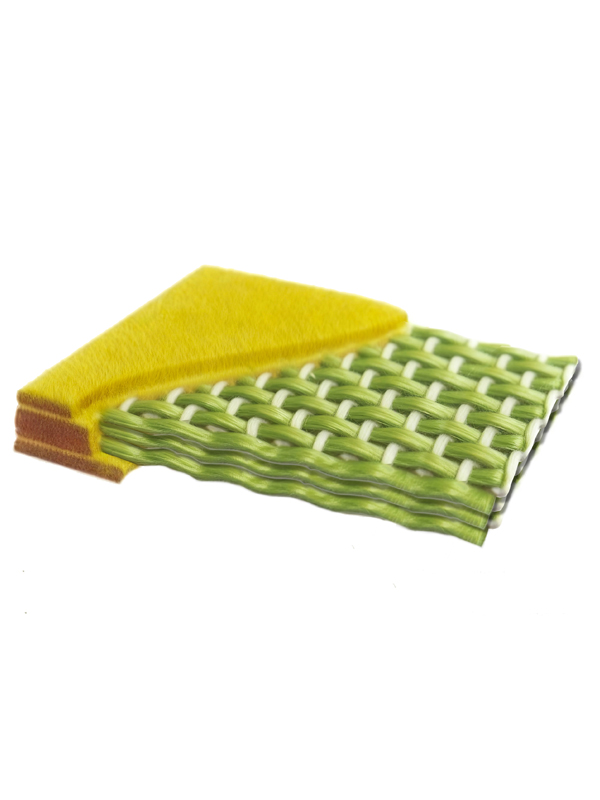
Technical requirements include:
- Double warp beam system with independent tension control
- Enhanced shedding capacity (16-32 harness frames typical)
- Heavy-duty beat-up mechanism for dense constructions
- Precision weft insertion maintaining layer alignment
- Automated fault detection for binding point errors
Double Weave Fabric Technical Textile Applications
Industrial Separation and Filtration Uses
Double weave fabric technical textile applications dominate industrial filtration. The dual-layer structure creates precise pore geometry. It provides mechanical strength. It maintains dimensional stability under load.
Filtration applications include:
- Press filters for chemical and mineral processing
- Belt filters for sewage sludge dewatering
- Vacuum drum filters for pharmaceutical production
- Air filtration for clean room environments
- Liquid-solid separation in food processing
Pore size control ranges from 5 microns to 500 microns. This depends on thread count and yarn diameter. Double weave achieves tighter tolerances than single-layer alternatives.
Medical and Protective Equipment Applications
Medical textiles exploit double weave properties. The structure creates barrier fabrics. It maintains breathability. It provides strength for repeated sterilization.
Medical applications include:
- Surgical gown reinforcement panels
- Implantable mesh structures
- Wound dressing substrates
- Pressure garment construction
- Medical packaging for sterilization maintenance
Redcolor's High-Performance Production Capacity
Suzhou Redcolor operates integrated production. Spinning facilities create custom yarns. Texturing adds elasticity and bulk. Weaving transforms these into double structures. This integration enables quality control at each stage. It supports custom engineering for technical applications. The 60 million meter annual capacity includes significant double weave allocation.
Air Jet Loom Double Weave Production
Air Jet vs. Rapier Loom Comparison for Double Weave
Air jet loom double weave production offers specific advantages. Air jet looms use compressed air for weft insertion. They achieve high speeds. They maintain precision for technical fabrics.
Loom type comparison for double weave:
| Parameter | Air Jet Loom | Rapier Loom |
| Maximum Speed | 800-1200 rpm | 400-600 rpm |
| Weft Insertion Force | Air pressure (gentle on delicate yarns) | Mechanical grip (positive control) |
| Color Change Capability | 4-8 colors typical | 12-16 colors possible |
| Energy Consumption | Lower per meter (compressed air systems) | Higher (mechanical drive systems) |
| Double Weave Suitability | Excellent for standard technical fabrics | Better for complex multi-color patterns |
| Maintenance Requirements | Moderate (air system maintenance) | Higher (rapier head wear) |
| Initial Investment | Moderate | Higher |
Tension Control in Dual Layer Synchronization
Double weave success depends on tension management. Two warp beams feed simultaneously. Uneven tension creates layer distortion. It causes binding point misalignment.
Tension control systems include:
- Electronic warp let-off with individual beam control
- Load cell feedback maintaining ±2% tension variance
- Active compensation for beam diameter changes
- Synchronized drive systems preventing layer skew
Proper tension achieves:
- Parallel layer alignment within 0.5mm per meter
- Consistent binding point positioning
- Uniform fabric thickness throughout roll length
- Minimal residual stress preventing post-weaving distortion
Annual 60 Million Meter Manufacturing Scale
Suzhou Redcolor's production scale supports technical textile volume requirements. The 60 million meter annual output includes substantial double weave capacity. Large-scale production enables raw material purchasing advantages. It supports consistent quality through statistical process control. It provides scheduling flexibility for urgent technical orders.
Double Weave Jacquard Pattern Design
Electronic Jacquard Integration with Double Weave
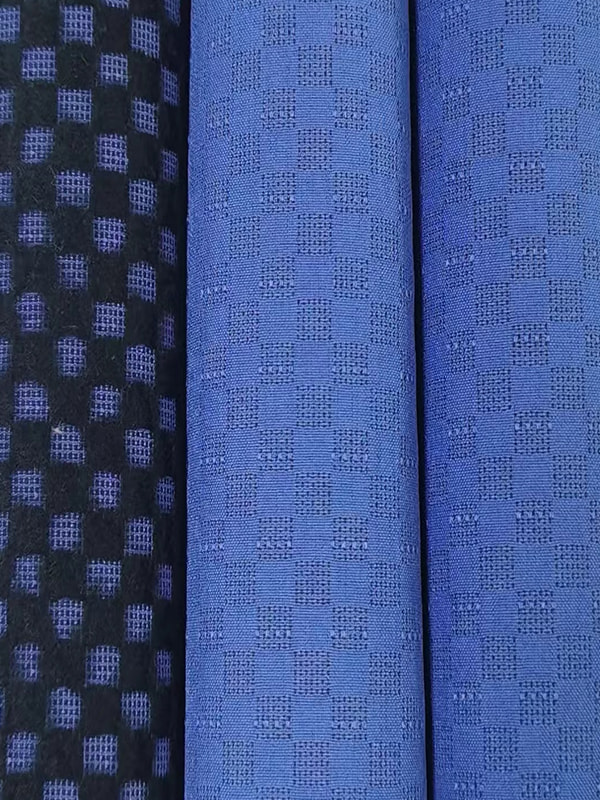
Double weave jacquard pattern design combines structural complexity with visual sophistication. Electronic jacquard systems control individual warp threads. They create intricate patterns within double layer structures.
Technical capabilities include:
- 2688 to 6144 hooks controlling individual warp ends
- Pattern repeat lengths up to 20,000 picks without repetition
- Variable binding point density creating textured surfaces
- Color blocking through layer-specific yarn selection
- 3D effects through differential layer shrinkage
Binding Point Engineering for Pattern Clarity
Binding points affect both structure and appearance. Strategic placement creates design elements. It maintains fabric integrity.
Binding point strategies include:
- Regular binding: Uniform intervals for consistent hand feel
- Scattered binding: Random placement for textural interest
- Patterned binding: Figurative designs visible on fabric surface
- Functional binding: Concentrated at stress points for reinforcement
Binding frequency affects performance:
- High frequency (every 2-4 picks): Stiff hand, maximum stability
- Medium frequency (every 8-12 picks): Balanced drape and stability
- Low frequency (every 20+ picks): Soft hand, potential layer separation
Custom Design Services for Technical Markets
Suzhou Redcolor provides design engineering support. Their technical team analyzes application requirements. They develop binding patterns for specific performance needs. They optimize yarn selections for chemical and mechanical requirements. They create prototype samples for testing. This service supports OEM/ODM customers developing proprietary technical fabrics.
Industrial Double Weave Filter Fabric
Porosity Control Through Thread Count Variation
Industrial double weave filter fabric requires precise porosity engineering. Filtration efficiency depends on pore size distribution. It depends on open area percentage.
Porosity control methods include:
- Thread count variation: 20-200 threads per cm in each layer
- Yarn diameter selection: 0.1mm to 1.0mm monofilament or multifilament
- Crimp engineering affecting pore geometry
- Calendering post-weaving to reduce pore size 10-30%
Standard porosity ranges:
- Microfiltration: 0.1-10 micron rating, 5-15% open area
- Fine filtration: 10-50 micron rating, 15-25% open area
- Coarse filtration: 50-500 micron rating, 25-40% open area
Chemical Resistance in Synthetic Fiber Selection
Filter fabric longevity depends on fiber chemistry. Different environments require specific polymers.
Fiber selection matrix:
| Fiber Type | Max Temperature | Acid Resistance | Alkali Resistance | Abrasion Resistance | Typical Cost |
| Polyester (PET) | 150°C | Good (pH 3-11) | Moderate | Excellent | 1.0 baseline |
| Polyamide (PA6/66) | 120°C | Poor (strong acids) | Good | Very Good | 1.2x |
| Polypropylene (PP) | 100°C | Excellent | Excellent | Good | 0.8x |
| Polytetrafluoroethylene (PTFE) | 260°C | Superior | Superior | Moderate | 8-10x |
| Polyetheretherketone (PEEK) | 250°C | Excellent | Excellent | Excellent | 15-20x |
Wujiang and Siyang Production Base Capabilities
Suzhou Redcolor operates two manufacturing locations. The Wujiang base focuses on high-end technical fabrics. It handles complex double weave with jacquard patterns. The Siyang base manages high-volume standard specifications. It provides cost optimization for large orders. This dual-base structure offers flexibility. It matches production location to order requirements.
Double Weave vs Triple Weave Comparison
Structural Complexity and Manufacturing Economics
Double weave vs triple weave comparison reveals important trade-offs. Triple weave adds a third layer. This increases complexity significantly.
Structural comparison:
| Parameter | Double Weave | Triple Weave |
| Layer Count | 2 | 3 |
| Minimum Warp Beams | 2 | 3 |
| Harness Frames Required | 16-24 | 24-40 |
| Production Speed | Standard | 40-60% slower |
| Quality Control Complexity | Moderate | High |
| Raw Material Efficiency | Good | Lower (more complex) |
| Relative Manufacturing Cost | 1.0 baseline | 2.5-4.0x |
| Minimum Order Quantity | 1000-3000m | 5000m+ (setup cost amortization) |
Performance Trade-offs in Filtration Efficiency
Triple weave offers specific advantages. It creates gradient density structures. It provides multiple filtration stages in one fabric. However, double weave often suffices.
Performance considerations:
- Double weave achieves most industrial filtration requirements
- Triple weave benefits specialized applications (hydraulic filtration, precision air)
- Double weave offers better cost-performance ratio for standard applications
- Triple weave shows advantages in depth filtration versus surface filtration
OEM/ODM Flexibility for Custom Specifications
Suzhou Redcolor offers both double and triple weave capabilities. Their OEM/ODM services include structure recommendation. They analyze customer filtration requirements. They suggest appropriate complexity level. They avoid over-engineering. This optimizes cost while meeting performance specifications.
How to Evaluate Double Weave Suppliers
Technical Textile Quality Metrics
Supplier evaluation requires specific technical assessment. Request documentation of:
- Loom specifications (harness count, warp beam configuration)
- Tension control system capabilities
- Quality control procedures (inspection frequency, testing equipment)
- Certification scope (ISO 9001, technical textile standards)
- Development capability (sample lead time, minimums for custom)
- Production capacity (monthly meters, current utilization)
Testing capabilities should include:
- Air permeability testing (Frazier or Gurley methods)
- Tensile and tear strength testing
- Pore size analysis (bubble point or image analysis)
- Chemical resistance testing for filter applications
- Dimensional stability testing (washing and heat exposure)
Redcolor's Integrated Spin-to-Trade Advantage
Suzhou Redcolor's structure provides distinct supply chain benefits. They control spinning. They control texturing. They control weaving. They control trade. This integration offers:
- Raw material traceability from polymer chip to finished fabric
- Quality control at each processing stage
- Lead time reduction eliminating inter-company delays
- Cost transparency without multiple margin layers
- Technical problem-solving with full process knowledge
The 60 million meter annual scale provides reliability. It supports volume requirements. It maintains quality consistency. It enables competitive pricing for technical textile markets.
Frequently Asked Questions
What is the minimum order quantity for custom double weave fabrics?
Standard double weave MOQ is 3000 meters per specification. This covers setup costs for beam preparation and harness configuration. For stocked greige goods, 1000 meter minimums apply. Triple weave requires 5000 meter minimums due to complex setup. Suzhou Redcolor accommodates smaller test orders for established partners at premium pricing.
How do you ensure layer alignment in double weave production?
We maintain layer alignment through electronic tension control. Independent warp beams use load cell feedback. Tension variance stays within ±2%. Automated edge detection systems monitor layer position. Real-time adjustments prevent skew. Quality inspection includes layer alignment measurement every 500 meters.
Can double weave fabrics achieve different properties on each face?
Yes. Double weave enables distinct face properties. The top layer can be fine and smooth. The bottom layer can be coarse and absorbent. Different yarn types per layer create functional differences. Binding point patterns can concentrate on one face. This creates technical fabrics with performance gradients.
What lead times should we expect for double weave orders?
Standard double weave from stocked yarn: 20-25 days. Custom yarn development adds 10-15 days. Complex jacquard patterns add 5-10 days for programming and testing. Triple weave extends lead times 30-50% due to slower production speeds. Suzhou Redcolor's dual-base structure provides scheduling flexibility. They prioritize urgent technical orders.
Do you provide technical documentation and certification?
Yes. Standard shipments include mill test reports. These show tensile strength, air permeability, and weight. Filter fabrics include bubble point pore size distribution. We provide ISO 9001 certification. We support customer audits of our Wujiang and Siyang facilities. Technical data sheets specify chemical resistance and temperature limits per fiber type.
Conclusion
Weaving double weave technology offers significant advantages for technical textile applications. Double weave fabric technical textile applications span filtration, medical, and industrial separation. Air jet loom double weave production provides efficient manufacturing for volume requirements. Double weave jacquard pattern design adds visual and functional sophistication. Industrial double weave filter fabric requires precise porosity control and fiber selection. Double weave vs triple weave comparison reveals double weave's superior cost-performance for most applications. Suzhou Redcolor International Trading Co., Ltd., with integrated spin-to-trade capabilities and 60 million meter annual capacity, provides reliable sourcing for quality-conscious technical textile buyers.
References
- ASTM International, ASTM D737-18: Standard Test Method for Air Permeability of Textile Fabrics, West Conshohocken, PA, 2018.
- International Organization for Standardization, ISO 9073-15: Textiles - Test Methods for Nonwovens - Part 15: Determination of Air Permeability, Geneva, 2008.
- Adanur, S., Handbook of Weaving, CRC Press, Boca Raton, FL, 2001.
- Gokarneshan, N., et al., "Weaving: Contemporary Design and Technology," Textile Institute, Manchester, 2019.
- American Society of Mechanical Engineers, ASME PTC 39-2005: Air Filtration Devices, New York, 2005.
- European Committee for Standardization, EN 12941: Respiratory Protective Devices - Powered Filtering Devices, Brussels, 2018.
- International Organization for Standardization, ISO 9001:2015 Quality Management Systems - Requirements, Geneva, 2015.
Contact Us for More Details
Don't hesitate to contact when you need us!
Product Categories
Contact Information
-
NO.1 Huanhu Road(Building I)Pingwang, Wu Jiang, Suzhou, Jiangsu, China
-
+86-13962557213
-
+86-512-80739991-801
-
+86-512-80739990
